Thursday, June 17, 2010

Cornhole 250 News: Park-o to appear at Kum & Go

(crapwagon.com 6-17-10)

clutch x
Again, only in the .1rl. Ya can't make this stuff up....

"Of note: E85 for 85 cents a gallon and meet Marco Andretti? What a deal. The Andretti Autosport driver will greet patrons at the Kum & Go (2110 Guthrie St. in Des Moines) from 5:30-7:30 p.m. June 17. Premium unleaded will be offered for 10 cents off per gallon. … Jake McVey and Jessie James will perform on stage after the checkered flag of the Iowa Corn Indy 250 presented by Pioneer."

Where?/Who?/Perform what?!


Road America
Jessie James is hot, everything else in that article is meaningless.


last2brake
Is that where they teach you the difference between a white flag and a yellow flag ?


Indy
Danica = Kum & Go Slowly


TRPG
Danica = Rahal Kum & Get an irl seat


TheAngryDwarf
Is the Kum and Go for real?

Seriously?

To me, it truly sounds like a vicious nick name for the high school whore.

But, then again, this is the Earl.

Wonder how Randy is liking this now?


DirtDevil1
funny how a few short seasons ago, Marko & young Rahole
were both promising young American F1 hopefuls.
Fast Forward 2010, Rahal Jr's nothing more than FIRL ride beggar, &
Marcos peddling beer and smokes at the local Cum & Go
Neither one will ever turn F1 wheel, maybe a top 10 in prestigious
FIRL Iowa Corn Cob 150

Long live the Vision...


scorpion
Kum and Go? Gawd only in places like Iowa or Indianer. Makes sense though that Marco is out peddling his wares. My understanding is (and yes I actually checked) there are still tons of good seats in the cornfest bowl for the race. Plus daddy needs Marco to suck up some cash for RHR's last race.


last2brake
I'll be there on Sunday !

Did you get good seats ?


Ronbo
"cough" baloney.."cough"...


TheAngryDwarf
Oh, come on, Ronbo.

Everybody know that L2B is a closet gomersexual.

(And with that, I run away, and run fast away, for fast I shall run away,and far shall I run away fast.)

gomersexual.

Damn, I crack myself up sometimes.

Thursday, June 10, 2010

Tuesday, June 8, 2010

IRL think tank has its hands full

(by Terry Blount espn.go.com 6-7-10)


Somewhere in Indianapolis on Monday, the long-term fate of IndyCar racing is being determined by a handful of men behind closed doors.

That might sound a little melodramatic, but the three-day secret session going on now for the Indy Racing League's advisory committee -- open-wheel racing's version of a Washington think tank -- will determine the key decision these men make about the future of the IndyCar Series.

Seven men with various expertise in racing, along with new league CEO Randy Bernard, are listening intently (at least let's hope they are listening intently) to proposals from chassis designers making their pitch for the car of the future.

This is so important that the committee has a highly decorated retired general to oversee the proceedings. Gen. William Looney III, who learned a thing or two about speed and technology in his distinguished career with the Air Force, is moderating the meetings.

Now doesn't that sound exciting? Sure it does, if you enjoy watching C-SPAN or reading engineering textbooks.

But these meetings, which conclude on Tuesday, aren't just about choosing a new car to race in 2012. Based on what they see and hear, these men will try to set a course to a brighter future for American open-wheel racing.

The five chassis designs on the table run the gamut of imagination -- from the traditional look of today's Indy car science to something that comes closer in appearance to science fiction.

The right decision could propel Indy car racing back to its former glory. The wrong decision could bury it for good. And everyone on the panel knows it.

So, no pressure, guys. Just go with your gut instinct.

The men in the power seats include Eddie Gossage, Tony Cotman, Gil de Ferran, Brian Barnhart, Tony Purnell, Neil Ressler and Rick Long. I won't bore you with all their credentials, but they bring an ocean of racing knowledge to the table.

In the end, the IRL can accept or reject their recommendation, but the reality is these men are the Supreme Court.

And every man on this panel realizes the IRL needs to make a big splash. It needs this decision to take some attention away from NASCAR and bring casual fans back to IndyCar. It needs to create some hoopla, but it needs to do it with substance.

No one knows for sure how the committee is leaning. Every man on the panel has been sworn to secrecy. But there are some clues that came last week from the committee's selection of a new engine formula -- a six-cylinder, turbo-charged motor.

"Bringing innovation and diversity back into Indy cars is something we felt was very important," said de Ferran, a team owner and former IRL driver who spoke to reporters at Texas Motor Speedway this past weekend. "It's also very important to be cost-effective."

The committee announced an engine plan that it hopes will help it achieve its goal of bringing in as many manufacturers as possible. Honda is the only engine supplier now.

Could that be the same goal for the future car? It isn't as easy as running competing engine manufacturers, which know they must follow basic rules in engine size and power.

The futuristic Delta Wing car, which looks a little like the car Craig Breedlove drove in 1960 while setting land-speed records at the Bonneville Salt Flats, has nothing in common with the Lola design, which more closely resembles the current IndyCar chassis from Dallara.

How do you make those radically different designs relatively equal for competition?

Picking more than one design could be the easy way out for the committee. If it chooses one chassis design, some fans will like it and some won't. Some fans want a futuristic look; some want a traditional look.

Finding a way to satisfy both and keep the competition balanced is the tough part.

After hearing all the proposals this week, the committee has only three weeks to make a decision. The stated goal is to announce a new chassis by June 30. Clearly that means picking a new car without extensive track testing.

"We have 18 months to get the car ready," said Barnhart, the IndyCar Series' president of competition.

It's a lot to work out in a short time. Does the car meet all the necessary safety requirements? Does it produce competitive racing on ovals and road courses?

If not, can it be altered to meet those requirements? The league doesn't want to pick a car that flops in testing and gives the impression that the series is heading in the wrong direction before the new car officially debuts.

NASCAR made that mistake with the Car of Tomorrow, which many fans hated before it ever raced.

So take detailed notes in these meetings, gentlemen. Listen well and give it all you've got. Deliberate with passion during the next few weeks.

Oh, to be a fly on the wall. It's bound to get a little heated at times. That's OK. It's pretty darn important stuff.

The fate of IndyCar racing rests in your hands. Make it count.

Thursday, June 3, 2010

IRL urged to act over Conway crash

(by Simon Strang autosport.com 6-3-10)

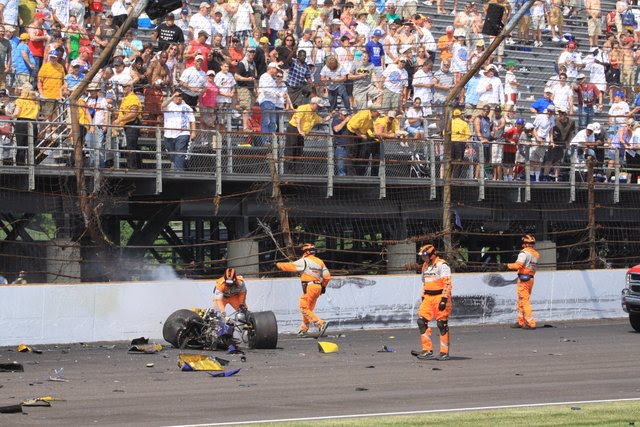
Double Indianapolis 500 winner Arie Luyendyk and former Marlboro 500 winner Mark Blundell have called on the IndyCar Series to act to curb teams employing fuel-saving strategies on ovals in the aftermath of Mike Conway's accident.

The Briton sustained broken vertebrae and compound fractures to his left leg when his Dreyer & Reinbold car vaulted over the back of Ryan Hunter-Reay's Andretti Autosport Dallara during this year's Indianapolis event.

The accident happened when the American's car began to run out of fuel while trying to make it to the finish in eighth place.

Blundell, Conway's manager, believes that the IRL should consider introducing regulations to prevent a similar accident in the future, adding that the 26-year-old - who will require a further operation following the five-hour one he had on Monday - could not have avoided hitting Hunter-Reay.

"What happened on Sunday could have been avoided," Blundell told AUTOSPORT. "There could have been a fatality, not just on track, but also in the crowd.

"They need to do something about it so that it doesn't happen again. If you haven't driven an IndyCar at those speeds, you could never understand, but there is nothing a driver can do in those situations. If a driver has run out of fuel and is coasting on the racing line, you simply have no time to react at all."

Blundell wants to see rules introduced to ensure that drivers have to finish the race on a minimum amount of fuel - to avoid running out altogether - or be forced to run on the low line of the track if they are in fuel-saving mode, so that faster runners know to avoid them.

Several drivers were lapping off their optimum pace in a bid to make their fuel go the distance on Sunday.

"The Indy Racing League needs to look at it," he said. "There should be one that forces drivers to run on the low line if they are in fuel-saving mode, or stay up high out of the way, but either way never take the racing line with the speed differences involved because it can be as much as 80mph.

"They were black-flagging drivers for blocking during the race, which is fair enough, because that is dangerous, but the speed differential was only between two and five mph. There were cars at the end of the race going at 150mph while others were doing 220.

"Mike had a strategy that saw him running flat out for 500 miles and that's the name of the game - 500 miles. Plus race control had several laps to assess the difference in speed between the leaders low on fuel and the guys coming back through the pack at full racing speed. There should be a mechanism in place to avoid this happening again.

"The bottom line," he added, "is that they need to introduce a rule to ensure drivers finish with fuel in the tank. That would take some of this kind of thing away."

In a statement, the Indy Racing League's CEO Brian Barnhart explained that the event's organisers always tell competitors to head for the apron if their car hits trouble and that this was the case on Sunday.

"Like every other race, when a car is running out of fuel or having a mechanical problem, we implore the driver to move as quickly as possible to the apron of the track and out of the way of traffic," said Barnhart. "With the timing of the incident at Indy, Ryan's car just began to sputter and there was no time for him to pull out of the line of traffic before impact was made."

Luyendyk - who won two Indy 500s, in 1990 and '97, and coached Conway in this year's event – said that while it was understandable that drivers were allowed to try and save fuel at the end of the race, it was unacceptable for cars to run out altogether on fast ovals.

"The IRL needs to change the rules because normally if you're running way off the pace on an oval they black flag you to prevent accidents because of the huge speed difference – the closing rates are so great," he said. "In this case they let everybody out, which is understandable because all the front-runners were off the pace saving fuel with a few laps left, but to actually run out of fuel cannot happen on an oval especially with the speeds and speed differential.

"Mike had nowhere to go, he was running 220mph laps and most others [were running] around 200. I believe there is a rule in F1 to have 1.5 gallons of fuel left in the car at the conclusion of a race. It would be a good rule to have that here."