Showing posts with label nascar. Show all posts

Saturday, July 5, 2025

American Thunder: NASCAR to Le Mans - Official Trailer | Prime Video


I watched this a couple of weeks ago on Prime. It was insane!

I don't follow NASCAR much so I guess I shouldn't be surprised that I had no idea this even happened. They raced a Cup car at Le Mans, (with a lot of adjustments obviously) and they finished quite well.

I would highly recommend checking it out if you have Prime, you won't be disappointed. 

Oh, and hats off to the mechanics. You'll see what I mean when you watch it but they were the ones that got the car over the finish line.

Sunday, February 24, 2013

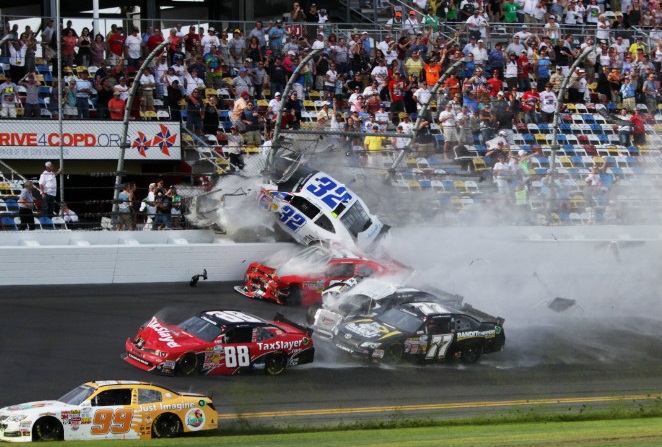
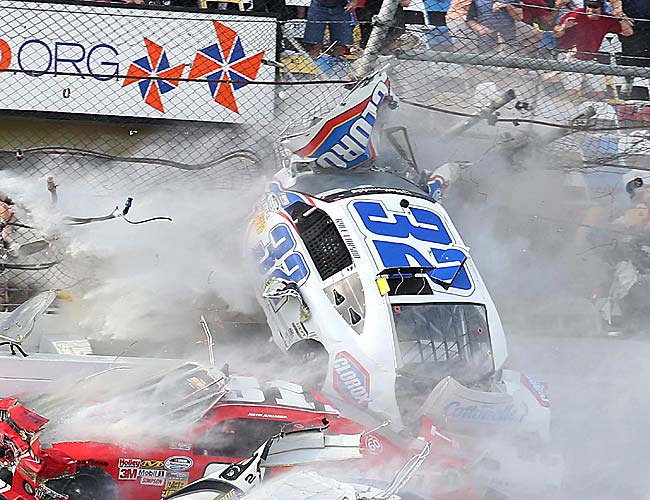
Injuries in the stands at Daytona Nationwide Race


(cnn.com 2-23-13)

Debris flew into the stands, injuring a number of spectators -- at least two of them critically -- during a jaw-dropping crash Saturday in the final turn of a NASCAR race at Daytona International Speedway.

The multicar crash occurred near the end of the Nationwide Series Drive4COPD 300 race at the same Florida track where Sunday's Daytona 500 will be held.

The race had recently restarted after another wreck, after which driver Michael Annett was hospitalized for bruising to his chest, according to Richard Petty Motorsports.

Several closely-packed cars were jostling for position at top speed when they got tangled up, setting off a dangerous chain reaction that ensnared a number of vehicles.

Reigning Sprint Cup champ Brad Keselowski -- who later told CNN he and others were simply "going for the win" -- was among those involved, while Tony Stewart somehow emerged unscathed and finished by winning the race.

Driver Kyle Larson's vehicle ended up flying into a fence that separates the track from spectators. It broke into pieces -- including tires and a fiery engine.

Larson walked away from the crash, even after the front part of his No. 32 car was completely gone. He and the other nine drivers involved told reporters that they were checked at a medical tent on the Daytona infield and released.

Some of the shredded debris flew into the barrier, while others got into the stands -- some of it reaching the second level about 20 feet up.

A video posted on YouTube shows a cloud of debris flying into stands and one man gasping, "Oh, my God." A tire rests on one seat, as a man frantically waves and yells to get the attention of paramedics.

Afterward, several spectators could be seen lying down after apparently suffering injuries. A line of about 10 ambulances lined up on the track, with some first responders carrying stretchers.

Fourteen fans were treated at an on-site medical facility, while 14 others were transported to area hospitals, speedway president Joie Chitwood told reporters.

"I'm just hoping everyone is OK," said Keselowski. "As drivers, we assume the risk. But fans do not."

NASCAR president Mike Helton earlier told ESPN, which was broadcasting the race, some people were taken to Halifax Health Medical Center. He said the protective fence did its job in preventing potentially more injuries and possibly deaths.

Byron Cogdell, a spokesman for the hospital, told CNN that his facility was treating 12 patients. Two of those -- one of them a child -- are in critical but stable condition.

"Everybody appears to be in stable condition," Cogdell said.

Staff at Florida Hospital Memorial Medical Center were treating one person and expecting three more, spokeswoman Lindsay Rew said Saturday evening.

The injured include Eddie Huckaby, a 53-year-old Krum, Texas, resident who suffered a leg gash when a large piece of metal hit him as he was watching the race, his brother Terry Huckaby told CNN affiliate WKMG. He described the motor landing in the stands, as well as a wheel "and everything flying over your head and debris everywhere."

"He's doing fine," Terry Huckaby said of his brother, who underwent surgery at Halifax Health Medical Center. "The first thing he said, 'I don't want to miss that (Daytona 500) race, but I have to watch on TV.'"

Accidents are nothing new to NASCAR, where cars often cruise at speeds topping 190 mph, nor to the Daytona track. One of the sport's most horrific, and well-known, wrecks happened in the 2001 Daytona 500, when famed driver Dale Earnhardt Sr. was killed -- also, on that race's final lap.

Still, injuries and fatalities to spectators are much rarer.

With the stands having been quickly evacuated, crews worked to repair the damaged fence. Chitwood expressed confidence the 55th edition of the Daytona 500 would go on as planned, with spectators even sitting in the same seats struck by debris Saturday.

"With the fence being prepared tonight to our safety protocols, we expect to go racing tomorrow with no changes," Chitwood said.

Thursday, May 5, 2011

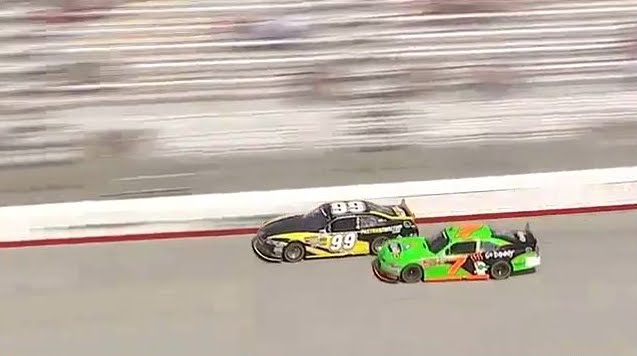
Proof Danica is the Pouting Princess

Danica causes an accident and in pure Pouting Princess style she blames someone else.


Friday, March 25, 2011

Wednesday, March 9, 2011

Sunday, February 20, 2011

Bayne youngest Daytona 500 winner, ends Wood Brothers drought


(cbssports.com 2-20-11)

Trevor Bayne finally made a mistake. Fortunately for him, it didn't happen until he missed the turn pulling into Victory Lane at the Daytona 500.

The youngest driver to win the Great American Race gave the historic Wood Brothers team its fifth Daytona 500 victory -- its first since 1976 with David Pearson -- and Bayne did it in a No. 21 Ford that was retrofitted to resemble Pearson's famed ride.

In just his second Sprint Cup start, the 20-year-old Bayne stunned NASCAR's biggest names with a thrilling overtime win Sunday at Daytona International Speedway, holding off Carl Edwards after fan favorite Dale Earnhardt Jr. crashed in NASCAR's first attempt at a green-white-checkered flag finish.

"Our first 500, are you kidding me?" said Bayne, who needed directions to Victory Lane. "Wow. This is unbelievable."

Unbelievable, indeed.

Just one day after celebrating his 20th birthday and leaving his teenage years behind, the sport's biggest race was captured by an aw-shucks Tennessean who shaves once a week and considers Rugrats his favorite TV show.

When he found himself at the front, and victory just two laps away, he never thought it would last. Bayne was content just to say he had been leading at the start of the green-white-checkered.

"I'm a little bit worried that one of them is going to come after me tonight," he said. "I'm going to have to sleep with one eye open. That's why I said I felt a little undeserving. I'm leading, and I'm saying, 'Who can I push?'"

Bayne thought for sure Tony Stewart or someone else would attempt to pass.

Nobody did.

"We get to turn four, and we were still leading the band," he said. "It seemed a little bit too easy there at the end."

The rookie had been great throughout Speedweeks, even proving his mettle by pushing four-time champion Jeff Gordon for most of a qualifying race.

"I figured they had a chance after seeing that boy race in the 150s," said Pearson, who will be inducted into the Hall of Fame in May. "I talked to him this morning. I told him to keep his head straight and not to do anything crazy. I told him to stay relaxed. I'm proud of him."

With the win Bayne breaks Gordon's mark as the youngest winner in Daytona 500 history. Gordon was 25 when he won the 500 in 1997.

"I think it's very cool. Trevor's a good kid, and I love the Wood Brothers," Gordon said. "I'm really happy for him. And I think it's great for the sport. To have a young talent like that -- he's got that spark, you know?"

The victory for NASCAR pioneers Leonard and Glen Wood ended a 10-year-losing streak, and came the week of the 10th anniversary of Dale Earnhardt's fatal accident on the last lap of the 2001 Daytona 500.

This was only the fourth win in the past 20 years for Wood Brothers, which hasn't run a full Sprint Cup season since 2006.

"When you miss a race, like the Daytona 500, it's like somebody died," said Eddie Wood, part of the second generation of Woods now running the team. "When you walk through the garage and you run into people you see every week, they don't look at you, they don't know what to say."

The rebuild has been slow, and they got Bayne this year for 17 races, on loaner from Roush-Fenway Racing, the team that snatched him up late last season when Michael Waltrip Racing -- which gave Bayne his start in 2009 -- couldn't promise a sponsor for this season.

So it was on to Roush, which plans for Bayne to run for the Nationwide Series title this season, and a deal was made to get him some seat time in the Cup Series with the Woods. It wouldn't be for points, and he wasn't eligible to run for rookie of the year.

But the stunning Daytona 500 win -- and the $1,462,563 payday -- might change everybody's plans. The team already said it will now go to Martinsville, the sixth race of the season, which had not been on its original schedule.

Bayne could possibly retract his decision to run for the Nationwide title.

"I don't even know if that's an option," Bayne said.

Sunday's race had a record 74 lead changes among 22 drivers, and a record 16 cautions that wiped out many of the leaders, including Earnhardt Jr. on the first attempt at NASCAR's version of overtime. It put Bayne out front with a slew of unusual suspects.

David Ragan, winless in 147 career starts, was actually leading the field on NASCAR's first attempt at a green-white-checkered finish. But he was flagged for changing lanes before the starting line, then an accident that collected Earnhardt in the middle of the pack brought out the caution, and Bayne inherited the lead.

But he had two-time series champion Stewart, now winless in 13 career Daytona 500s, lurking behind with veterans Bobby Labonte, Mark Martin and Kurt Busch, who had collected two previous wins over Speedweeks. All were chomping at the bit for their first Daytona 500 title, but Bayne never blinked, holding his gas pedal down wide open as he staved off every challenge over the two-lap final shootout.

"It was too easy," Bayne said.

Edwards wound up second in a Ford and was followed by David Gilliland, Labonte and Busch.

Juan Pablo Montoya was sixth, Regan Smith seventh, and Kyle Busch, Paul Menard and Martin rounded out the top 10.

Earnhardt Jr. wound up 24th.

The race was a battle of attrition, thanks to the dicey two-car tandem racing at nearly 200 mph that was the norm throughout Speedweeks.

Hendrick Motorsports had a rough start to the season as three of the team's four cars, including five-time defending Sprint Cup Series champion Jimmie Johnson, were involved in an early 14-car wreck.

Gordon, who started on the front row, and Martin also sustained damage in the melee.

Gordon questioned the aggressiveness of his fellow drivers, especially so early in the race.

"What I don't quite understand is why guys are doing it three-wide, three-deep running for 28th," he said.


Friday, October 23, 2009

Is NASCAR playing it too safe?

(by Ed Hinton espn.go.com 10-22-09)

I shall now ask you the fans the toughest, touchiest, most personal, most politically incorrect question I have ever asked you:

Is racing dangerous enough for you anymore?

This bears asking, in light of your massively expressed discontent and growing apathy toward NASCAR. I wonder if the radical reduction of danger in the safety revolution isn't at the root of it all.

Don't get me wrong. I never have been one of those who believed the masses came to motor races to see people get killed.

But I have always believed you came, in some measure, to sense that death and serious injury were being narrowly avoided before your eyes.

I could hear it in your thunderous cheers whenever a Dale Earnhardt or a Tim Richmond would climb out of a demolished car and wave to the crowd. Or a Rick Mears would rise laughing out of a pile of rubble at Indy.

Before Jimmie Johnson rocketed from obscurity at the lesser levels to astounding success in Cup, his entire career highlight film lasted less than a minute: one horrific crash at Watkins Glen, head-on into a barrier that exploded; he jumped right out of the wreckage and onto the roof of his Busch car, and thrust both arms skyward.

Both he and the crowd were clearly exhilarated by his triumph over near-disaster. I wonder if your current apathy toward him is, in part, because he's had no moments like that in Cup.

I'm not pushing you onto a psychiatric couch here. I'm just asking about human nature, the anthropological fact of fascination with, say, the high-wire artist, the matador, the Navy SEAL, or -- in the analogy once drawn for me by NASCAR president Mike Helton -- the fighter pilot.

Atop that list of the daring, for more than a century between the first automobile race in 1894 and this, the fruition of the racing safety revolution, was the racing driver.

These past few years you have told me in droves that NASCAR has become boring -- "BO-ring," you often spell it -- via e-mail and comments on the ESPN Conversation pages. Yet NASCAR publicists bombard me constantly with computer-acquired "loop data" meant to prove, mathematically, that there's more passing, closer racing, fewer runaway wins than ever before.

So all I can rely on are my own eyes and memory, and I cannot for the life of me see that the racing is any more or less boring than it ever was whenever fields get strung out, and someone leads and leads and leads. Johnson does it, but so did Richard Petty.

You roundly say you despise the Car of Tomorrow because it's awkward and further dampens the racing, and because it is essentially a kit car neutered of make.

The new car is aesthetically ugly beyond question, and drivers tell us it's a handful and a clunker. Beyond that, I can't see how it has necessarily hurt the racing -- unless we're constantly watching the driver, inside the car, fighting the wheel and the brake pedal.

As for brand identification, they all looked the same to me a decade before the COT came along. It started in 1997 when NASCAR let Ford get away with a racing Taurus that looked nothing like a street Taurus, and the aerodynamics war went out of control from there, until they were all prototypes, none recognizable from the showroom namesakes.

I wonder whether the real issue with the new car, conscious or subconscious, is that its purpose has been too thoroughly fulfilled -- that it is too safe.

You say the drivers, including Johnson, are mostly vanilla. I wonder if it's more that you don't detect that distinct aura of swagger in men who knew and accepted, whenever a starting grid rolled off the pit road, that they might not make it back.

For the record, no journalist was more vocal than I on behalf of the HANS, soft walls, safer seats, moving the driver more toward the center of the car, and energy-dissipating materials in the cars.

It had gotten to the point that the price of the occasional reminders of the danger was too dear. I'd written too many accounts from too many racetracks where the pall of death or career-ending injury lay palpable and miserable.

I still feel that way. I still applaud, standing, NASCAR's adoption of every single safety measure, and more, advocated by the experts I brought into the discussion in the terrible outbreak of death by basilar skull fracture in 2000-01. Most of those Ph.D.s and M.D.s are now paid consultants for NASCAR.

Still I wonder whether, in doing the right thing -- the only thing, given the scientific capabilities -- racing has had to remove a rudimentary element of its electrifying appeal: the intangible edge on the human spirit during an event that involves high risk.

For a few months after the day Earnhardt didn't climb out, Feb. 18, 2001 at Daytona, NASCAR's television ratings spiked to their highest levels ever. They have declined, pretty much steadily, ever since.

In death he finally made the cover of Sports Illustrated, a place I'd failed to get him in life, during the nine years I worked there, through the prime of his career. Its sister magazine, Time, put him on the cover too, with a story that contained some information I'd written in SI stories that didn't make the cover, information now deemed more interesting to the masses because he was suddenly dead.

Driving the TV-ratings spike in the Earnhardt aftermath were male viewers ages 18-34, the demographic advertisers covet most. After the TV roller coaster, I kept getting this image of youth in droves, parking their dirt bikes and skateboards and saying to one another, "Man, dudes actually die at this NASCAR stuff, so I better check it out."

Then, HANS devices in place, soft walls under construction, danger radically reduced, the youths apparently returned to watching the X Games.

But throughout the aftermath of Earnhardt I felt this: He himself wouldn't have been disgusted by it all, for nobody understood the mass appeal of danger more than Earnhardt. It made him, he knew. And it would destroy him, he seemed to sense all along. And he accepted that.

He once showed me a letter from a woman asking him to drive her husband's hearse from the church to the grave. It had been the man's dying wish.

I knew how Earnhardt was -- he wouldn't go to funerals even for close friends such as Neil Bonnett and Davey Allison. Death was too real, too looming in his own life, too clear and present a danger to Earnhardt all the time.

Knowing this, and having been the victim of his chops-busting humor many a time, I went right back at him over the hearse-driving request. I dropped the letter onto the coffee table between us and asked, "Well? Did you do it?"

"Shee-ee-ee-IT, no!" he said.

And then he muttered: "I'll be in one of them bitches soon enough."

This was six-plus years before his death. Only months before it, amid much driver unrest over the deaths of Adam Petty and Kenny Irwin Jr., Earnhardt famously admonished his skittish peers:

"Put a kerosene rag around your ankles so the ants won't climb up there and eat your candy ass."

I wonder if that isn't what you miss most about him, the seven championships and 76 wins just being the rationale on which you would have rioted had he been left out of NASCAR's very first Hall of Fame class.

But Earnhardt was the paradox of indescribable enormity in NASCAR. A realm always on the bittersweet edge of danger due to the occasional reminders, the deaths of lesser names, could not bear the death of its biggest, its literally most-worshipped star ever.

This was too much. Something had to be done.

It was a flashback to what had happened in Formula One in 1994, when its own man deemed invulnerable to dying in a race car, Ayrton Senna, was killed at Imola, Italy.

The very next race, at Monaco, I sat with F1 czar Bernie Ecclestone in his motor coach in the paddock on race morning, saw the urgency in his face as he looked me in the eye, and heard him utter the words that would begin the worldwide safety revolution that, by now, has changed the electrifying nature of motor racing everywhere forever:

"It is necessary to give out the message to the world that we're not people who don't care."

They had to end the image of blood sport, even in the one so long regarded as the most dangerous -- and therefore somehow romantic -- sport of all, Grand Prix racing.

That they did. The high-tech safety revolution began, though it would not reach NASCAR for seven more years, and the very real death of its own perceived immortal, Earnhardt.

By 1997, Jacques Villeneuve, soon after winning the world driving championship, got into big trouble with the FIA for telling the BBC that Formula One was losing its appeal because it just wasn't dangerous enough anymore.

This was not from a cavalier driver in youthful denial. Nobody in F1 understood death on the track better, more personally. His father, Gilles Villeneuve, had been killed when Jacques was only 11, during qualifying for the Belgian Grand Prix in 1982.

Yet what Jacques said was terribly incorrect politically, because F1 was in the third year of its massive safety and public-relations overhaul.

That didn't mean he wasn't right.

Joey Logano's recent wreck at Dover is a prime example of how we in the media grasp at any remaining straw of the danger element, try to magnify it, bring it back.

The very idea that Logano could have been seriously hurt in that car, in that seat, wearing that helmet and HANS, in that simple rollover, was -- well -- borderline absurd.

But he said it scared him -- of course it did, in a generation of drivers who seem to sense they're playing video games until the simulator jars them enough to remind them that crashing really can hurt.

The commentators were breathless as the replays of Logano's roll went on and on, in slow motion and real time, ad nauseam.

See? Grasping at a straw of something fleeting, nearly gone, trying to bring it back.

We all are human and we all are mortal and we all are trying to deal with that, and seeing the nearness of death is somehow a part of our preparation.

My longtime friend and writing guru, Frank Deford, broke his career-long silence on the subject of auto racing -- he'd often kidded me about the garishness of it -- in the aftermath of Earnhardt. NASCAR, Deford concluded, is indeed "a slice of American life … and death."

Our greatest living novelist, the enigmatic Cormac McCarthy, slipped out of seclusion a couple of years ago for one TV interview, in which he said he does not understand writers who do not deal in matters of life and death.

Given racing today, I wonder if the man who gained fame and fortune by being the most overtly human and mortal of us all, Ernest Hemingway, would have said what he said: "There are only three sports: bullfighting, motor racing and mountaineering, all the others being games."

I wonder if he'd have listed only two. He's not around to ask, so I'm asking you:

Have science and society and their mandates to do the right thing, the humane thing, and the pundits like me who preached it …

Have we reduced your once-deadly, once-electrifying sport to just another game?

Tuesday, August 11, 2009

Cool NASCAR pic


Patrick Carpentier restarts his car after a shunt at Watkins Glen.